Sub-region
Orvieto DOC is a historic white wine appellation straddling Umbria and northern Lazio. Known for its fresh, gently aromatic blends based on Grechetto and Trebbiano Toscano, it produces both dry and sweet wines. Once famed throughout Europe, Orvieto has reinvented itself as a source of crisp, food-friendly whites with good value and quiet regional character.
1
11
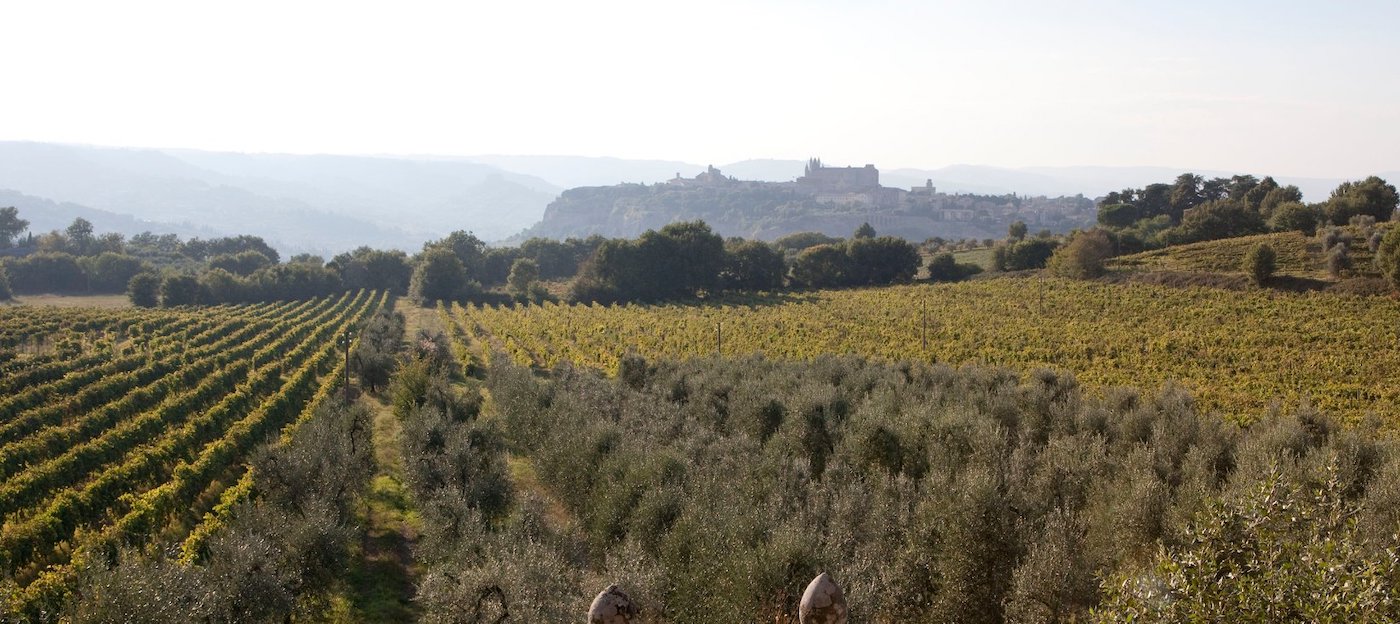
Orvieto DOC spans the hills surrounding the ancient city of Orvieto, perched on volcanic tuff in southwest Umbria and extending into northern Lazio. The appellation is predominantly known for white wines made from a blend of indigenous and international grapes. Its wines are generally light to medium-bodied, fresh, and slightly floral, often enjoyed as aperitifs or versatile table companions.
The landscape is one of rolling hills, clay and volcanic soils, and a moderate climate that supports crisp, clean styles. Although often overshadowed by more prominent Italian white wine regions, Orvieto remains one of central Italy’s most consistent producers of affordable, well-balanced whites. Recent efforts by quality-minded producers are helping to raise its reputation with more focused, terroir-driven bottlings.
The Orvieto area has been associated with wine since Etruscan times, with archaeological evidence of winemaking stretching back to the 7th century BCE. During the Middle Ages and Renaissance, Orvieto was celebrated for its sweet wines, which were highly prized by the Papal Court and exported across Europe.
In the 20th century, the region shifted to producing mostly dry white wines, with large cooperatives dominating production. The DOC was created in 1971, and for many years the wines were seen as simple and commercial. However, the historical prestige of Orvieto remains a reference point, and a handful of producers are reviving its identity with renewed focus on quality and indigenous grape varieties.
Orvieto’s vineyards lie on hills between 150 and 500 meters above sea level, with soils composed of volcanic tuff, clay, sand, and limestone. The region’s geology is ancient, formed from the eruptions and sedimentation of the Tiber Valley over millennia. The tuffaceous subsoils retain heat and moisture, which helps vines in the warm, dry summers.
The climate is Mediterranean with continental influence, marked by warm days and cool nights that preserve acidity and aromatic expression. The best vineyards are located in the Classico zone, where the combination of elevation, drainage, and exposure provides ideal conditions for balanced ripening. These environmental factors contribute to wines that are fresh, mineral, and restrained in style.
The main grapes in Orvieto DOC are Grechetto and Trebbiano Toscano (Procanico), which together must comprise at least 60% of the blend. Grechetto contributes structure, herbal tones, and stone fruit character, while Trebbiano brings volume and acidity. Grechetto is increasingly prized by producers aiming for more defined, age-worthy wines.
Other permitted varieties include Drupeggio, which adds floral and citrus notes; Verdello, which brings freshness; and Malvasia Toscana, valued for aromatics and softness. International varieties are not permitted under the DOC but are grown in the region under IGT classifications. Producers are increasingly experimenting with single-varietal Grechetto wines to express site-specific character and raise quality standards.
The Orvieto DOC allows for both dry (secco) and sweet (abboccato, amabile, dolce) white wines, as well as a Classico designation for wines from the historic core zone surrounding the city of Orvieto. Dry Orvieto is by far the most common style, though semi-sweet and sweet versions are still made in small quantities. The blend must consist of 60–100% Trebbiano Toscano (locally known as Procanico) and Grechetto, with the remaining 0–40% coming from Drupeggio, Verdello, and/or Malvasia Toscana. Chardonnay is also a permitted secondary variety. A Superiore designation is available for wines with lower yields, slightly higher minimum alcohol (12%), and stricter ageing requirements. Sparkling (Spumante) Orvieto is permitted but rarely seen.
Wines labelled Orvieto DOC must contain at least 60% Trebbiano Toscano and/or Grechetto, with the remaining portion drawn from approved local varieties. Minimum alcohol levels are 11% for standard wines, 12% for Superiore, and yields are capped at 13 tonnes per hectare for standard and 10 tonnes for Superiore.
The Classico designation may be used for wines from the traditional growing zone, with no additional production rules beyond geographic origin. Spumante wines may be produced under the DOC but are rare. All wines must be vinified and bottled within the designated DOC zone to use the label. Labelling terms such as secco, amabile, dolce, or abboccato are used to denote sweetness levels.
Orvieto has long been seen as a source of inexpensive, easy-drinking white wines, but the past two decades have seen a quiet shift toward quality and authenticity. Producers are lowering yields, using better clones of Grechetto, and fermenting with native yeasts to bring out terroir character. Stainless steel remains common, though some are experimenting with neutral oak and extended lees contact.
There’s also growing interest in reviving Orvieto’s sweet wine heritage, particularly among producers who remember the region’s historical prestige. Single-varietal Grechetto wines and Classico zone bottlings are being used to signal higher quality, while some estates are moving toward organic certification. The challenge remains visibility and overcoming outdated perceptions, but the foundation for a renaissance is being laid.
Decugnano dei Barbi is a leading estate known for structured, age-worthy Orvieto Superiore wines that blend tradition with modern finesse. Palazzone, situated in the Classico zone, produces benchmark examples of both dry and late-harvest Orvieto, often with an emphasis on Grechetto. Argillae, a younger estate, has brought renewed energy to the region with fresh, terroir-conscious bottlings.
Barberani, located near Lake Corbara, is also instrumental in raising quality levels, especially with botrytised and single-vineyard wines. Custodi and Sergio Mottura contribute to the region’s reputation for clean, balanced whites. The Orvieto produced by Antinori’s Castello della Sala is worth a mention too.
For a classic, mineral-driven dry white, try Palazzone Terre Vineate Orvieto Classico Superiore or Decugnano dei Barbi Il Bianco, both showing restraint and texture. Barberani Luigi e Giovanna is a standout for late-harvest sweetness balanced by acidity. Argillae Orvieto Superiore offers a fresh, everyday style with lifted aromatics.
For something more distinctive, look for Grechetto dei Colli Martani DOC or Castello della Sala’s Cervaro della Sala(labelled IGT), which show the grape’s potential in oak-aged, structured formats. These wines highlight the quiet versatility of central Italy’s white wine heritage—and Orvieto’s evolving role within it.
With its beautifully preserved old town, unique cliff-top setting and famous foodie culture, the enchanting city of Orvieto is one of Italy’s hidden treasures.
Perched high on a volcanic plateau above the Umbrian hills and populated since Etruscan times, Orvieto is an ancient fortress city with an abundance of charm. Often viewed as a day trip destination on account of its accessible location between Florence and Rome, visitors who spend a little longer here will be rewarded with incredible architecture, gourmet cuisine and unspoilt scenery.
Wander the winding streets of Orvieto’s medieval centre, explore the labyrinth of tunnels and caves that lie beneath the city, take coffee - or lunch - at Enoteca al Duomo, marvel at the stunning cathedral with its exquisite facade, admire the jaw-dropping landscape of olive groves, cypress trees and vineyards, and then sample some of the region’s prized wines at one of the many atmospheric bars that pepper the city’s charming cobbled alleyways.
Although only a small city, Orvieto offers a broad range of accommodation with everything from urban boltholes to rustic rural retreats. If a central location and contemporary comforts are amongst your priorities then Hotel Palazzo Piccolomini - a 16th century palace turned four star hotel - is a solid choice within the city. But if you’re looking for something a little further afield, then Antichi Casali di Charme - a 78 hectare estate tucked away in the Umbrian hills - offers unique and exclusive accommodation in a serene setting. Similarly, around ten minutes drive from the city, Locanda Palazzone delivers elegant, informal luxury, a superb restaurant and spectacular views to Orvieto and the surrounding countryside. Both of these also offer guests a range of viticultural and gastronomic activities from guided tastings and tours of the vineyards / winery, to truffle hunts and cookery classes.
As with all Italian cities, food and wine are an important part of the fabric here. Much of the focus is on seasonality, sustainability and simplicity with regional produce such as wild boar, black truffles and Caciotta, championed in the city’s celebrated cuisine. Amongst the many high quality restaurants in town, I Sette Consoli with its creative contemporary menu, beautiful orchard garden and 900 label strong wine cellar, and La Palomba - a rustic family-run trattoria serving Umbrian specialities - are particularly notable.
The same is true of the city’s drinking dens. From the quaint and quirky to the modern and minimalistic, Orvieto’s bars are bound by a common passion for local wines and a convivial atmosphere. Plates of truffle bruschetta, cured meats and local cheeses are often served to accompany plummy Umbrian reds and elegant, dry whites. The aforementioned Enoteca al Duomo and the irresistibly charming Bottega Vèra are favourites amongst visitors and locals, but almost everywhere here comes recommended.
So if you’re looking for an off-the-radar food and wine destination, with a dramatic setting and bags of history, you’d be hard pressed to find anywhere better than Orvieto.

