Region
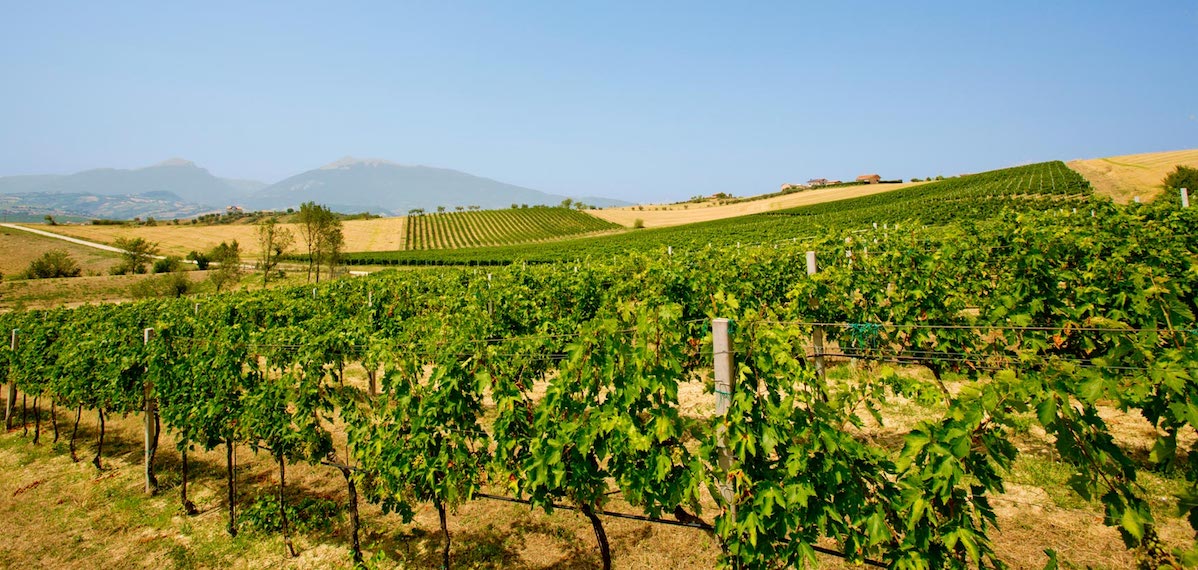
Abruzzo is a central Italian region famed for good value red from Montepulciano d'Abruzzo and white wines from Trebbiano d'Abruzzo, as well as a growing focus on local varieties such as Pecorino and Passerina.
2
36
Abruzzo lies in central Italy, stretching from the high Apennine mountains to the Adriatic Sea, nestled between Le Marche to the north, Lazio to the west, and Molise to the south. Though often perceived as rugged and remote, Abruzzo possesses a captivating blend of wild nature, rural tradition, and coastal beauty. The region is one of Italy’s most mountainous, with a dramatic interior dominated by the Gran Sasso and Maiella massifs, while the eastern flank softens into rolling hills that descend toward sandy beaches and fishing towns. Despite its proximity to Rome, Abruzzo has remained authentically agricultural, defined by small farms, shepherd culture, and strong local identities.
Abruzzo’s cuisine is robust and deeply seasonal—lamb skewers (arrosticini), mountain lentils, spicy sausages, and sheep’s milk cheeses in the interior; brodetto di pesce, mussels, and olive oil along the coast. The wines mirror this landscape and lifestyle: hearty, generous reds and zesty, aromatic whites that speak more to place than polish. Though long associated with bulk wine production, Abruzzo has undergone a quiet transformation over the past two decades. A new generation of producers is embracing the region’s native grapes, altitudinal variation, and old vines, making Abruzzo one of Italy’s most dynamic and promising wine regions today.
Wine has been produced in Abruzzo since pre-Roman times, with the Vestini, Marrucini, and Peligni tribes cultivating vines before Roman conquest. The Greeks and Romans expanded viticulture in the coastal plains and foothills, and writers like Pliny the Elder referenced the quality of local wines. During the Middle Ages, vineyards were maintained by monastic communities and feudal estates, though production remained largely for local consumption. For centuries, the region’s isolation and rugged geography limited its economic development, keeping winemaking a subsistence practicetied to mixed farming.
In the 20th century, especially post-WWII, Abruzzo became known for large-scale, cooperative-based production, focused on Montepulciano d’Abruzzo and Trebbiano d’Abruzzo—reliable, inexpensive wines that often lacked distinction. However, in the 1980s and ’90s, producers like Emidio Pepe and Valentini began to challenge this narrative, crafting deeply expressive, long-lived wines from native grapes and old vines, using traditional methods. Their success inspired others, and today a growing number of family-run estates and ambitious cooperatives are working to elevate quality, embrace terroir, and explore altitude, soil diversity, and natural winemaking. Abruzzo is now increasingly viewed as a region of hidden gems, where tradition and innovation meet with compelling results.
Abruzzo’s terroir is defined by its mountain-to-sea topography, with most vineyards planted on hillsides between 200 and 500 meters above sea level, where diurnal temperature shifts, calcareous soils, and breezes from both the Adriatic and Apennines combine to create ideal growing conditions. The Gran Sasso and Maiella mountains act as climate moderators, sheltering vineyards from excessive heat while retaining freshness and aromatics. The soils vary widely, from clay-limestone and sandy loams near the coast to rockier, stonier soils at higher elevations.
The best Montepulciano wines come from mid-altitude slopes where drainage and sun exposure are optimized. In areas like Teramo and L’Aquila, the influence of altitude creates more elegant, fresher wines with lifted aromatics and firmer tannins. In Chieti, the warmer climate yields riper styles, often with richer fruit and softer structure. For white varieties like Pecorino and Trebbiano Abruzzese, hillside sites with good ventilation and morning sun are ideal, preserving acidity and aromatic intensity. This diverse terroir base is increasingly being mapped and studied, allowing winemakers to tailor grape selection and farming to the specific needs of each microclimate, a key trend in the region’s quality evolution.
The Montepulciano grape is Abruzzo’s calling card—distinct from the Tuscan town of the same name—and is known for producing deep-colored, robust reds with notes of black cherry, plum, licorice, and earth, coupled with velvety tannins and balanced acidity. It ripens relatively late and thrives on hillsides with good sun exposure. While often vinified for early drinking, in top sites and under careful vinification, it can yield profound, age-worthy wines. Cerasuolo d’Abruzzo, made from the same grape, is a standout rosato category: richly hued, structured, and flavorful, blurring the line between rosé and red.
Among whites, Trebbiano Abruzzese is favored over the more neutral Trebbiano Toscano. It produces wines of delicate citrus, white peach, and almond notes, often with surprising depth when old vines and traditional methods are employed. Pecorino, once thought extinct, has made a spectacular comeback. It is early-ripening yet retains excellent acidity, yielding textured, aromatic wines with hints of pear, herbs, and minerality. Passerina, another ancient white variety, plays a supporting role, offering freshness and florality. International varieties like Chardonnay, Sauvignon Blanc, Merlot, and Cabernet Sauvignon are also grown, particularly in IGT-labeled wines, but the region’s energy is clearly shifting back to its native grapes and identity.
The backbone of Abruzzo’s appellation system is Montepulciano d’Abruzzo DOC, which stretches across most of the region’s eastern flank and produces the famed red wine from the Montepulciano grape. While much of it comes from the flatlands and is vinified for everyday consumption, the best examples come from hillside vineyards—especially in the Colline Teramane subzone, which was elevated to DOCG status in 2003 as Montepulciano d’Abruzzo Colline Teramane DOCG. These wines are deeper, more structured, and built for aging.
For whites, the Trebbiano d’Abruzzo DOC is the most widespread, encompassing wines from several Trebbiano biotypes, notably Trebbiano Abruzzese, which can yield wines of surprising complexity and longevity when carefully grown and vinified. Another rising star is Pecorino, which received its own DOC designation—Abruzzo DOC and Colline Pescaresi IGT, and more formally under Terre di Chieti IGT. Cerasuolo d’Abruzzo DOC, made from lightly macerated Montepulciano grapes, produces deep-colored rosé wines with serious structure and versatility, gaining international attention for their uniqueness.
Other DOCs include Controguerra DOC in the north, Ortona DOC and Tullum DOCG (elevated in 2019) in the south, and Villamagna DOC, a small but ambitious zone focused on age-worthy Montepulciano. The Terre di Chieti IGTcovers a broad area and serves as a platform for varietal wines and innovation, especially with white and international varieties.
Abruzzo is undergoing a quiet revolution, as producers move away from bulk production and embrace terroir-driven, site-specific viticulture. This shift is clearest in the elevation of Montepulciano: shorter macerations, less new oak, and better vineyard management are producing wines of refinement, balance, and transparency, especially in Colline Teramane and Villamagna. Simultaneously, Cerasuolo d’Abruzzo is being redefined—not as a byproduct, but as a serious rosé category, gaining traction in export markets for its originality and gastronomic potential.
White wines, too, are rising in quality. Producers are reviving Trebbiano Abruzzese and Pecorino, focusing on low yields, lees aging, and textural complexity, moving away from overcropped, neutral wines toward whites with minerality, tension, and character. There’s also growing interest in organic and biodynamic farming, especially among younger winemakers and those in inland, higher-altitude zones. Natural wine, while still niche, is establishing a foothold, particularly in L’Aquila and Teramo.
Perhaps most importantly, Abruzzo is gaining recognition as a source of value and authenticity. Its wines remain affordable yet increasingly compelling, making it an attractive region for consumers and sommeliers alike. With its blend of historic grapes, dramatic landscapes, and committed producers, Abruzzo is no longer a peripheral region—it is a central force in the future of Italian wine.

