Region
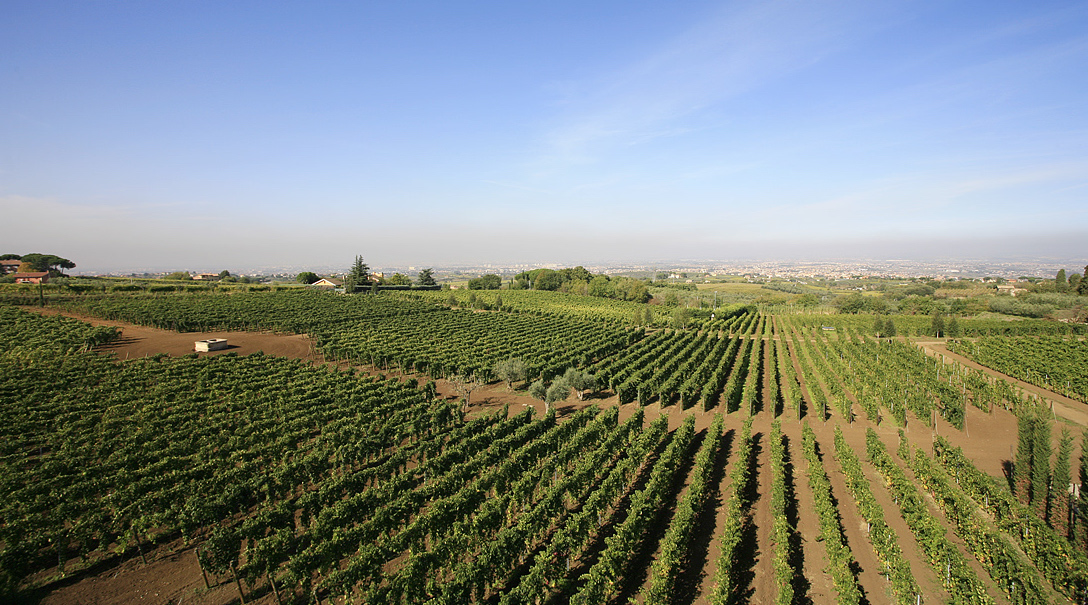
Lazio is a central Italian region known predominantly for the production of light and refreshing white wines. There is growing attention for the red Cesanese del Piglio.
30
Lazio, situated in central Italy along the Tyrrhenian Sea, is most famous for being home to Rome, the eternal city and historical heart of Western civilization. Yet beyond the capital’s imperial ruins and Renaissance splendor lies a landscape of volcanic hills, tranquil lakes, ancient villages, and fertile countryside, long shaped by agriculture and religious tradition. From the Monti Cimini and Alban Hills to the Pontine plain, Lazio’s varied topography is tied intimately to its culinary and winemaking identity.
The region's gastronomy is famously rustic and bold—cacio e pepe, amatriciana, porchetta, and artichokes alla romana—and its wines are made with a similar sense of purpose and place. Long overshadowed by Tuscany and Campania, Lazio’s wines have traditionally been light, fresh, and easy-drinking, often white, and produced for local consumption. But in recent years, a quiet renaissance has taken root, with renewed interest in indigenous grape varieties, volcanic terroir, and quality-driven production, led by a new wave of independent winemakers. Lazio today is emerging as one of Italy’s most intriguing and undervalued wine regions.
Lazio’s winemaking history stretches back to the Etruscans, who cultivated vines on the volcanic hills north of Rome, particularly around Lake Bolsena and Montefiascone. With the rise of the Roman Empire, Lazio became one of the most important wine-producing regions in the ancient world. Roman agronomists wrote extensively about viticulture, and wine flowed freely through the streets of the empire's capital. The surrounding countryside supplied Rome with an abundance of wine, stored in clay amphorae and transported via intricate road and river systems.
In the post-imperial period, Lazio's wine production persisted, mainly through monasteries and feudal estates, but it gradually lost its former glory. By the 20th century, the region was better known for bulk white wines than for quality, with grapes like Malvasia and Trebbiano grown in abundance for Roman trattorias. However, the late 20th and early 21st centuries saw a shift. Producers such as Falesco (Famiglia Cotarella), Sergio Mottura, and a new wave of small, experimental estates began to explore lower yields, older vines, and the potential of local varieties such as Cesanese, Malvasia Puntinata, and Grechetto Rosso (also called Rosso di San Lorenzo). Today, Lazio’s wine culture is experiencing a resurgence rooted in authenticity, with greater focus on site expression and natural farming.
Lazio’s terroir is defined by its volcanic origins, which have imparted the region with rich, mineral-laden soils particularly well-suited for white grape varieties. The Alban Hills, a collapsed volcanic caldera southeast of Rome, form the geological heart of the Frascati and Marino appellations. Here, vines grow on tufa and basalt-rich soils that retain heat while offering excellent drainage, encouraging slow, even ripening. The elevated slopes provide consistent ventilation, which helps preserve acidity and prevent disease, contributing to the region’s reputation for crisp, clean white wines.
Farther south and east, where red varieties dominate, the terrain becomes more varied. The hills around Piglio and Olevano Romano, home to the Cesanese del Piglio and Cesanese di Olevano Romano DOCs, are composed of limestone, clay, and marl, with altitudes reaching up to 600 meters. These soils, coupled with significant diurnal temperature shifts, create ideal conditions for Cesanese to develop complexity, structure, and aromatic lift. In northern Lazio, the Montefiascone zone lies near Lake Bolsena, where ancient volcanic deposits mix with sandy, silty soils and a more temperate climate. This area is conducive to lighter white wines with a softer, rounder profile. Overall, Lazio’s terroir is diverse but united by its volcanic backbone, which lends a distinctive mineral edge and freshness to many of its wines.
Lazio’s grape palette is a mix of ancient local varieties and more widely planted Italian types, with recent years witnessing a resurgence of interest in forgotten or underappreciated indigenous grapes. Among reds, Cesanese reigns supreme, especially in the southern DOCs. Known for its floral aromatics, fine tannins, and naturally high acidity, Cesanese thrives in the hills of Piglio, Affile, and Olevano Romano. The Cesanese di Affile clone, in particular, is prized for its depth and intensity. While once blended or diluted, it is now increasingly being vinified as a varietal wine of serious character and aging potential. Other reds include Montepulciano and Sangiovese, which appear in blends throughout the region, especially in the Colli della Sabina and Castelli Romani DOCs.
On the white side, Malvasia Puntinata, or Malvasia del Lazio, is the region’s most distinctive grape. More aromatic and lower-yielding than the commonly planted Malvasia Bianca di Candia, it imparts texture, floral notes, and freshness to Frascati and Marino wines. Trebbiano Toscano remains widespread but is often valued more for its blending potential than its character. A growing number of producers are turning to Bellone, an ancient local white grape that thrives in coastal areas and volcanic soils, producing wines with citrus, salinity, and phenolic grip. Grechetto and Chardonnay are also used in some DOCs and IGT wines, with Grechetto showing particular promise when treated with care. Increasingly, Lazio’s identity is being reshaped by the revival of its native grapes, bringing new energy to the region’s historically overlooked viticultural heritage.
Lazio, the central Italian region best known for being home to Rome, is experiencing a quiet renaissance in its wine sector. Long overshadowed by its more famous neighbors Tuscany and Umbria, Lazio is now drawing fresh attention for its volcanic terroir, native grape varieties, and a growing band of producers committed to quality over quantity. While the region boasts over thirty DOCs and three DOCGs, only a handful have achieved international recognition—yet this is beginning to change.
At the forefront of this transformation is Cesanese del Piglio DOCG, widely regarded as Lazio’s most promising red wine appellation. Situated in the undulating hills south of Rome near the town of Piglio, the area was granted DOCG status in 2008 and is centered on the Cesanese grape, particularly the esteemed Cesanese di Affile clone. The wines from this appellation are striking: deeply colored, intensely aromatic, and richly structured. Notes of dark cherry, violet, pepper, and wild herbs define the profile, while the wines’ balance of freshness and tannin offers impressive aging potential. Increasingly, Cesanese del Piglio is being viewed not just as Lazio’s finest red, but as one of central Italy’s hidden gems, capable of standing alongside more famous Italian reds in complexity and elegance.
The region’s other two DOCGs, Frascati Superiore and Cannellino di Frascati, are located in the Alban Hills, southeast of Rome. These volcanic slopes have been producing wine since ancient times, and Frascati in particular enjoys a historic reputation as Rome’s white wine of choice. Frascati Superiore DOCG is the dry, higher-quality iteration of the broader Frascati DOC, made mainly from Malvasia Bianca di Candia and Malvasia Puntinata, often blended with Trebbiano Toscano and other indigenous varieties. The result is a light, citrusy white wine with a mineral edge—especially when grown on higher-altitude sites with good drainage. Meanwhile, Cannellino di Frascati DOCG preserves a traditional style of late-harvest, semi-sweet wine, an echo of Lazio’s historical production of dessert wines. Though less commonly exported, it maintains a local fan base and connects modern viticulture with Lazio’s sweeter past.
Beyond the DOCG tier, Lazio is home to a wide array of DOC zones that reflect its geographic and stylistic diversity. The Frascati DOC, while more variable in quality, remains one of Italy’s most recognizable white wine appellations, especially popular in Rome’s trattorias. To the north, the curiously named Est! Est!! Est!!! di Montefiascone DOC, near Lake Bolsena, produces crisp, straightforward white wines from Trebbiano and Malvasia. Though it owes much of its fame to a medieval legend involving a wine-loving bishop, today its reputation rests more on local consumption than critical acclaim.
Among reds, Lazio’s other important Cesanese zones—Cesanese di Olevano Romano DOC and Cesanese di Affile DOC—are generating increasing interest. Each focuses on different expressions of the Cesanese grape, shaped by unique microclimates and soil types. Olevano Romano tends to produce softer, more accessible styles, while Affile’s wines are firmer, more structured, and often age-worthy. These DOCs serve as critical extensions of the Cesanese story, allowing winemakers to explore and elevate the grape across different terroirs.
Several other DOCs, such as Marino, Colli della Sabina, and Castelli Romani, offer both red and white wines from a mix of traditional varieties. Though many of these wines are still made in a rustic, everyday style, a growing number of producers are focusing on lower yields, site-specific farming, and minimal intervention in the cellar. Along Lazio’s Tyrrhenian coast, the Tarquinia, Circeo, and Zagarolo DOCs produce white and red wines that are often fruit-forward and fresh, benefiting from sea breezes and sandy soils. While few of these coastal wines have yet achieved international visibility, they offer distinctive local character and increasing potential as winemaking standards rise.
For producers looking beyond the constraints of the DOC system, the Lazio IGT offers valuable flexibility. It allows for experimentation with international varieties—including Chardonnay, Merlot, Cabernet Sauvignon, and Syrah—as well as blends and techniques that don’t fit within DOC guidelines. This has encouraged innovation, especially in volcanic zones and among younger winemakers interested in natural wine, amphora fermentation, and organic viticulture.
In sum, Lazio’s appellation system reflects a region in transition—from quantity to quality, from obscurity to recognition. While only a few zones have made a mark on the global stage, the diversity of terroirs, grapes, and wine styles points to a future that is increasingly nuanced, site-driven, and proudly rooted in tradition. As Lazio’s producers continue to refine their craft and champion indigenous varieties like Cesanese and Malvasia Puntinata, the region is poised to take its place among Italy’s most compelling and distinctive wine landscapes.
Lazio’s wine industry is undergoing a period of redefinition, as producers turn away from the region’s legacy of mass-market, characterless wines and embrace a more artisanal, site-driven approach. One of the most noticeable trends is the revival of indigenous varieties, particularly Cesanese and Malvasia Puntinata, which are now being made in both traditional and experimental styles. Producers are exploring single-vineyard bottlings, organic and biodynamic farming, and minimal intervention in the cellar to let terroir and grape character shine. The best wines now show precision, aromatic nuance, and a clear sense of place.
At the same time, there is a growing international curiosity about Lazio, particularly from sommeliers and importers looking for authentic Italian wines outside the mainstream. The proximity to Rome has also made the region a natural hub for wine tourism, which is helping to boost the visibility of high-quality estates. While some regions like Frascati still battle outdated reputations, younger winemakers and boutique producers are pushing the region in new directions, producing natural wines, skin-contact whites, and structured reds that appeal to modern wine audiences. Lazio is no longer simply Rome’s house wine—it is becoming one of Italy’s most intriguing regions for discovery.
