Region
Liguria covers the coastal area of North West Italy and is home to interesting low production wines.
15
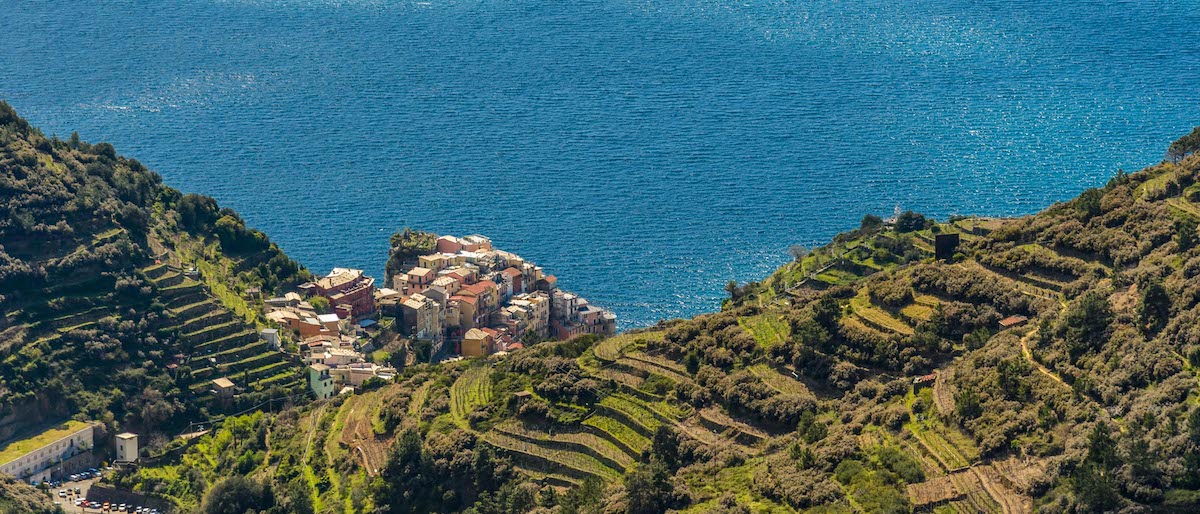
Liguria, a narrow coastal crescent in northwestern Italy, clings to the mountains between the Apennines and the Ligurian Sea, forming one of Italy’s most strikingly beautiful and geologically dramatic wine regions. With France to the west, Piedmont to the north, and Tuscany to the east, Liguria is a land of steep cliffs, terraced hillsides, and medieval fishing villages that seem to grow out of the rock itself. The region’s compact size, varied microclimates, and maritime exposure give it a unique cultural and agricultural identity—one shaped more by sea trade and mountain isolation than by large-scale commerce. From the glamour of Portofino to the rugged paths of Cinque Terre, Liguria offers a sensorial richness rooted in place, history, and tradition.
Ligurian culture is resourceful, refined, and understated, and its gastronomy is among the most distinctive in Italy. Local specialties like pesto alla genovese, focaccia, olive oil from Taggiasca olives, and seafood dishes like trofie al pesto con patate e fagiolini reflect the region’s reliance on herbs, grains, and coastal bounty. Wine, though produced in small quantities, is tightly woven into this culinary identity. The steep, narrow vineyards demand heroic viticulture and are often planted in ancient terraces supported by dry-stone walls. Liguria’s wines—particularly its whites—mirror the region’s character: bright, saline, aromatic, and built on subtlety rather than power. While never a volume powerhouse, Liguria has become one of Italy’s most compelling regions for artisan, terroir-driven wines.
Viticulture in Liguria dates back to the Etruscans and Greeks, but it was the Romans who developed it more systematically, carving terraces into cliffsides and integrating wine into trade routes along the Via Aurelia. In the Middle Ages, monastic orders cultivated vineyards throughout the region, often in harsh, isolated plots. The Republic of Genoa later fostered a flourishing maritime trade, which included Ligurian wines—especially sweet and fortified types destined for export. For centuries, winegrowing remained a labor-intensive, largely subsistence activity. The difficulty of vineyard work in Liguria’s vertical terrain limited expansion and encouraged local consumption rather than commercial ambition.
The 20th century brought significant challenges. Industrialization and depopulation led many to abandon the region’s most difficult vineyards, especially in areas like Cinque Terre, where terraces collapsed and vines were overtaken by scrub. But beginning in the 1970s and ’80s, a revival began. Inspired by preservationists, local cooperatives, and a new generation of winemakers, terraced vineyards were reclaimed, local grapes were studied and protected, and Ligurian wine began to reassert its identity. In the 21st century, Liguria has emerged as a boutique region, with producers embracing low-intervention methods, native varieties, and a dedication to expressing the nuances of their dramatic coastal terroir.
Liguria’s terroir is defined by altitude, aspect, and proximity to the sea. Most vineyards are planted on steep, terraced slopes, often at altitudes between 100 and 600 meters above sea level, facing southeast or southwest to maximize sun exposure. Soils vary by zone, but common features include slate, schist, sandstone, and limestone, which offer excellent drainage and contribute to the wines’ mineral tension. The region’s narrow geography means that maritime influence is ubiquitous: cooling breezes, salt air, and high humidity all play a role in shaping the region’s fresh, saline style.
In Cinque Terre, the vineyards rise dramatically above the Ligurian Sea on ancient stone terraces called muretti. The proximity to the sea lends the wines a distinctive saline edge, while the intense sun and thin, rocky soils preserve acidity and aromatic purity. In the Riviera di Ponente, especially in Dolceacqua, vineyards are planted on sandstone and clay-limestone soils, often sheltered from wind and heat by surrounding hills, yielding reds with finesse and lift. In Colli di Luni, slightly inland, the soils are more alluvial and fertile, with a combination of river influence and foothill elevation, giving Vermentino more weight and ripeness. Liguria’s terroir is by nature extreme, with low yields, manual labor, and heroic viticulture necessary to coax character from every vine. The result is wines that reflect place, tension, and balance.
Liguria is home to a distinctive set of native and local grape varieties, many of which are grown nowhere else. Among whites, the most important is Vermentino, which dominates in Colli di Luni, Riviera Ligure di Ponente, and Golfo del Tigullio. Vermentino here ranges from light and citrusy to fuller-bodied and herbal, depending on soil and exposure. In the western Riviera, Pigato is a close relative (possibly a biotype) of Vermentino, yielding more textured wines with floral and peach-like aromatics. In Cinque Terre, the dominant white grapes are Bosco, Albarola, and Vermentino, often blended to create wines that are lean, salty, and brisk.
Among reds, Rossese (known as Tibouren in Provence) is the defining variety in Dolceacqua, producing wines that are pale in color but vibrant in flavor—marked by rose petal, crushed herbs, and forest berries. The best examples can age gracefully and show remarkable finesse. Dolcetto, Barbera, and Ciliegiolo are also grown, especially in the east, and often appear in blends under the Liguria and Colli di Luni DOCs. Other rare varieties include Granaccia (related to Grenache), Lumassina, and Rollo, all preserved by dedicated producers working in tiny quantities. Liguria’s grape identity is rooted in place-specific adaptation, with each variety reflecting the narrow valleys and coastal influences of its zone.
Liguria has no DOCGs, but several important DOCs, each associated with small-scale, high-quality production. The most internationally recognized is Cinque Terre DOC, located along the vertiginous cliffs of the eastern Riviera. Here, white wines are produced from Bosco, Albarola, and Vermentino, yielding delicate, mineral, and saline expressions that reflect the sea spray and sun of the terraced vineyards. A rare and historic dessert wine from the area, Sciacchetrà, is made from dried grapes and offers a honeyed, amber-hued expression of the same varieties.
In the west, near the French border, the Riviera Ligure di Ponente DOC encompasses a wide array of wines, but is best known for Pigato (a genetically distinct Vermentino clone) and Rossese di Dolceacqua, a fresh, perfumed red with floral, strawberry, and herbal notes. Rossese di Dolceacqua also has its own dedicated DOC, and when made from specific vineyards in the best exposures, the wines can show remarkable depth and elegance. Further inland, Colli di Luni DOCstraddles the border with Tuscany and is shared with that region. It produces Vermentino of greater body and structure, often with more herbal and stone fruit character.
Other DOCs include Val Polcevera DOC (near Genoa), known for field blends and sparkling wines; Golfo del Tigullio–Portofino DOC, which produces crisp, aromatic whites and light reds; and Colline di Levanto DOC, which overlaps with Cinque Terre and often produces high-quality, affordable Vermentino and red blends. Though fragmented and small in scale, Liguria’s appellations reflect microclimatic precision and local tradition, and are increasingly being championed by passionate vignerons.
Liguria’s most prominent trend is the rediscovery and refinement of native grapes through terroir-sensitive winemaking. Producers are increasingly embracing minimal intervention in the cellar—native yeast fermentations, low sulfur use, and gentle handling—to preserve the nuance of their raw materials. With such limited vineyard area, many growers focus on small, high-quality production, often from old vines and organically farmed plots. The heroic nature of Ligurian viticulture—steep slopes, manual labor, and low yields—naturally limits output, but enhances identity.
Another growing trend is the revival of Sciacchetrà, the historic sweet wine of Cinque Terre, made from sun-dried Bosco and Albarola grapes. Once nearly extinct, it is now championed by a handful of passionate producers aiming to reestablish it as a cultural and enological treasure. There is also increased attention to single-vineyard expressions of Rossese and Pigato, reflecting the nuance of Liguria’s varied microclimates. In an era of climate change and globalization, Liguria’s wines offer something precious: freshness, distinctiveness, and a deep connection to place. Though its wines remain niche and often hard to find, Liguria stands as one of Italy’s most artisanal and expressive wine regions—a coastal frontier of flavor, tradition, and resilience.
