Region
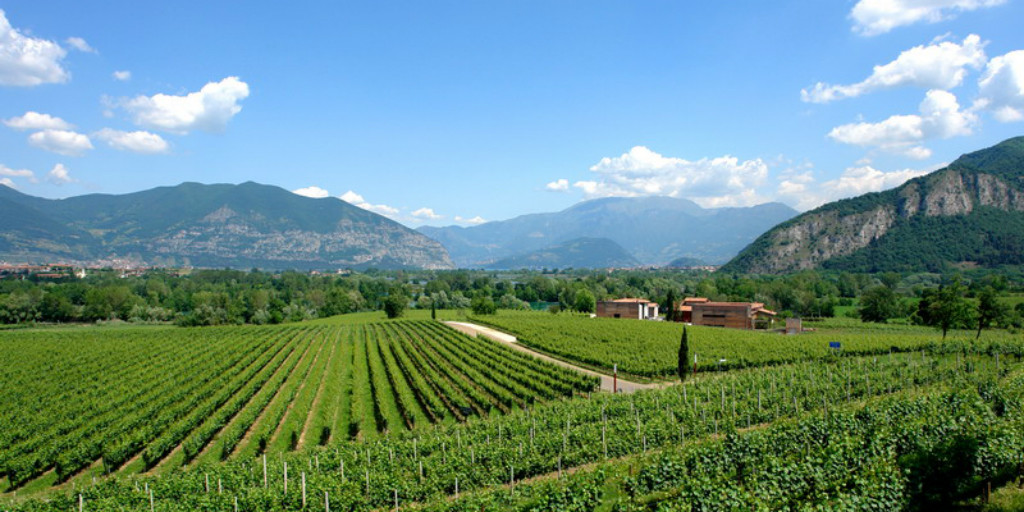
Lombardy, our Lombardia in Italian, occupies a large territory in the centre of northern Italy. It is best known for the traditional method sparkling Franciacorta as well as the cool climate reds of Valtellina.
46
Lombardy, or Lombardia, lies in northern Italy, bordered by Switzerland to the north and the regions of Piedmont, Emilia–Romagna, Veneto, and Trentino–Alto Adige. It is one of Italy’s most economically powerful and culturally complex regions, anchored by the dynamic metropolis of Milan. But beyond the bustle of finance and fashion, Lombardy is a landscape of lakes, alpine foothills, and ancient towns. The region’s geography is diverse, ranging from the snow-capped Alps and glacial lakes—Como, Garda, Iseo—to fertile plains in the Po Valley, and hilly viticultural zones shaped by both history and geology. Lombardy’s wine culture is often overshadowed by its urban sophistication, but it is home to some of Italy’s most refined and distinctive appellations.
Lombardy’s gastronomy reflects its northern identity and cold winters: risotti, polenta, ossobuco, and aged cheeses like Gorgonzola and Taleggio are staples. The wines of the region mirror this balance of richness and elegance—often understated, structured, and food-focused. From the high-altitude, Nebbiolo-based reds of Valtellina to the sparkling wines of Franciacorta, Lombardy’s viticulture is both traditional and forward-looking. It is a region where precision winemaking, cool-climate terroir, and a quiet respect for craftsmanship come together to produce wines of distinct personality and finesse.
Lombardy’s winemaking history dates back to the Etruscans and Celts, who cultivated vines along the northern lake shores and in the Alpine valleys. Roman records describe wine production in the area, and during the Middle Ages, monasteries and noble families expanded viticulture throughout the region. The Valtellina valley, in particular, has an uninterrupted winemaking tradition spanning more than a millennium, with vines painstakingly cultivated on stone-walled terraces carved into steep alpine slopes. Elsewhere, wines were traded along rivers and land routes that connected Lombardy with both central Italy and the transalpine world.
In the 20th century, Lombardy began to modernize, both in terms of viticulture and broader economic development. The post-war period saw increasing mechanization, but also the emergence of high-quality cooperatives, particularly in Valtellina. In the 1960s and ’70s, visionary producers in Franciacorta began experimenting with traditional method sparkling wine, eventually leading to Italy’s first sparkling DOCG, and establishing the region as the country’s answer to Champagne. Today, Lombardy continues to evolve: embracing site-specific viticulture, organic practices, and the rediscovery of forgotten local grapes, all while maintaining its role as a bridge between alpine rigor and Italian expressiveness.
Lombardy’s terroir is among the most geographically varied in Italy. In the north, the Valtellina vineyards cling to south-facing stone terraces on steep, sun-exposed slopes at elevations of 300–700 meters. The soils here are granitic and sandy, offering drainage and heat retention that help Nebbiolo ripen in an otherwise marginal climate. These conditions result in wines of light color, high acid, and striking aromatic complexity, with aging potential comparable to those of Barolo and Barbaresco, though generally more delicate.
Moving south, Franciacorta sits on ancient glacial deposits and morainic soils, with a climate moderated by Lake Iseoand the surrounding foothills. The combination of chalk, limestone, and clay allows for wines with both finesse and depth, particularly suitable for long lees-aged sparkling wines. In Oltrepò Pavese, the terroir is more rolling than mountainous, with limestone, marl, and clay soils supporting red and white varieties. Its cool, continental climate and elevation (up to 400 meters) provide excellent conditions for Pinot Nero, making the area one of Italy’s most promising zones for traditional method sparkling wines.
In the Lugana zone, soils are rich in clay and silt, remnants of ancient lakebeds, giving Turbiana wines a textural, mineral profile with balanced acidity. Other parts of Lombardy, such as the plains around Pavia and Mantua, are more productive and flat, better suited to high-yielding varieties and commercial wines. Overall, Lombardy’s terroirs combine alpine energy, glacial complexity, and lake-borne elegance, offering some of the most compelling cool-climate wines in Italy.
Lombardy’s grape landscape is defined by both native varieties and international grapes that have found ideal conditions in the region’s diverse terroirs. In Valtellina, the star is Chiavennasca, the local clone of Nebbiolo, producing lighter, high-acid wines with floral, wild strawberry, and herbal notes. Though less powerful than its Piedmontese cousin, it excels in finesse and transparency. In the south, particularly in Oltrepò Pavese, Pinot Nero (Pinot Noir) is widely planted and used both for still wines and traditional method sparkling wines, particularly under the Metodo Classico DOCG.
Among white varieties, Turbiana is central to Lugana DOC, producing mineral-driven, structured wines that age well. In Franciacorta, Chardonnay and Pinot Nero form the base for sparkling wine, sometimes blended with Pinot Bianco, although its use is declining. Riesling Italico, Croatina, Barbera, and Uva Rara are also widespread in the Oltrepò Pavese and surrounding areas, forming the basis of red blends like Bonarda dell’Oltrepò Pavese.
Lombardy also preserves rare native varieties such as Erbamat, an ancient white grape now allowed in Franciacorta blends for its high acidity and late ripening. Other minor grapes, including Marzemino, Incrocio Manzoni, and Rossola Nera, are cultivated in small plots, often by passionate growers focused on biodiversity and heritage. The region’s grape diversity reflects its geographic range, with different zones favoring different styles and varietal focuses.
Lombardy contains a rich patchwork of appellations—five DOCGs and over twenty DOCs—each tied closely to its subregion’s climate and topography. The most prestigious is Franciacorta DOCG, Italy’s leading traditional method sparkling wine, made primarily from Chardonnay, Pinot Nero, and Pinot Bianco. Located south of Lake Iseo, Franciacorta is celebrated for its chalky morainic soils, extended lees aging, and commitment to quality, producing sparkling wines that rival those of Champagne in structure and finesse.
To the north, the Valtellina Superiore DOCG and Sforzato di Valtellina DOCG dominate the alpine valley of Valtellina, near the Swiss border. These reds are made from Chiavennasca (the local name for Nebbiolo), yielding elegant, high-acid wines with floral, tarry complexity. Sforzato is made from partially dried grapes, producing a fuller-bodied, more concentrated style. The region also includes the broader Valtellina DOC, which allows for fresher, lighter expressions. In the southern Oltrepò Pavese, Oltrepò Pavese Metodo Classico DOCG highlights sparkling wines from Pinot Nero, while Oltrepò Pavese DOC encompasses a vast array of still wines, including Croatina, Barbera, and Riesling Italico.
Other important appellations include Lugana DOC, straddling the border with Veneto near Lake Garda, which produces mineral-driven whites from Turbiana (a close relative of Verdicchio). San Colombano al Lambro DOC, near Milan, and Valcalepio DOC, near Bergamo, are smaller but locally significant. Across Lombardy, there’s a marked split between cool, alpine terroirs, lake-moderated microclimates, and the lowland Po Valley zones, each producing wines of distinct personality.
Lombardy’s wine industry is experiencing a period of quiet confidence and stylistic refinement. In Franciacorta, producers are extending lees aging, experimenting with lower dosage, and focusing on single-vineyard and vintage cuvées, aiming for transparency of site and a more gastronomic profile. The renewed interest in Erbamat speaks to the region’s commitment to climate resilience and indigenous identity, even within an appellation known for international grapes.
In Valtellina, the trend is toward more artisanal, site-specific expressions of Nebbiolo, with younger producers reviving abandoned terraces and embracing organic farming. Winemakers are focusing on elegance over extraction, and highlighting subzones like Inferno, Grumello, and Sassella. Sforzato, once a novelty, is increasingly refined and less overtly sweet or oaky, offering a more balanced expression of dried-grape power.
Meanwhile, Oltrepò Pavese, long considered a bulk-wine zone, is undergoing a rebranding, driven by producers emphasizing Pinot Nero, Metodo Classico, and even ambitious still wines from old vines. Natural wine movements are also gaining ground, especially around Lake Iseo and in parts of the Colli Mantovani, where low-intervention winemaking meets unique microclimates.
Overall, Lombardy is moving steadily toward precision, regional authenticity, and cool-climate elegance. Its reputation may lag behind more famous regions, but among sommeliers and wine lovers, it is increasingly recognized as a source of serious, age-worthy, and highly distinctive wines born from discipline, altitude, and quiet innovation.
