Region
The Trentino and Alto Adige region is home to a variety of premium whites from local and international varieties and fresh, light reds.
13
32
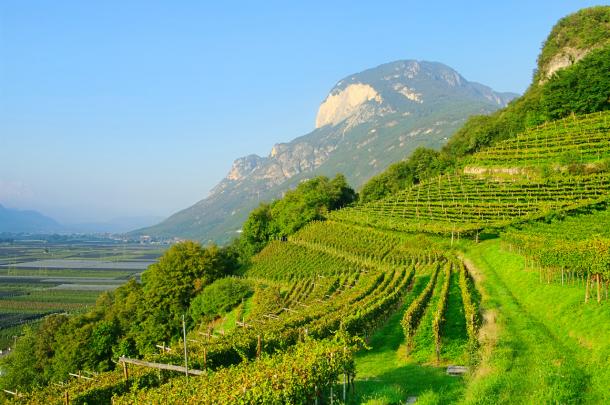
Trentino–Alto Adige, Italy’s northernmost wine region, is a dramatic alpine territory where snow-capped Dolomitesgive way to verdant river valleys and meticulously maintained vineyards. The region shares borders with Austria and Switzerland and is divided into two culturally distinct provinces: Trentino, with strong Italian heritage, and Alto Adige(also known as Südtirol), where German is widely spoken and the cultural identity is Austro-Hungarian. This duality is reflected in every aspect of life—from language and architecture to viticulture and cuisine. Mountain villages, frescoed churches, and Tyrolean farmhouses punctuate a landscape that is both pristine and carefully cultivated.
Culinarily, Trentino–Alto Adige marries northern Italian and central European traditions: speck, canederli (bread dumplings), polenta, and apple strudel all feature prominently. Its wines reflect the same fusion—structured yet pure, precise yet soulful. The region benefits from high altitudes, cool nights, and ample sunshine, making it ideal for producing white wines with vibrant acidity and aromatic clarity, as well as elegant reds. While not as widely recognized as Tuscany or Piedmont, Trentino–Alto Adige is celebrated among sommeliers and wine lovers for its consistency, focus on quality, and its role as a model for sustainable alpine viticulture.
The history of viticulture in Trentino–Alto Adige goes back over two thousand years. The Rhaetians, a pre-Roman Alpine people, are believed to have cultivated vines on the terraced hillsides long before Roman conquest. During Roman rule, viticulture expanded, especially along the Adige River, a vital trade route that helped link northern Italy with central Europe. In the Middle Ages, monastic orders, bishops, and noble families fostered the development of vineyards, many of which remain in production today. The Austro-Hungarian Empire, which ruled Alto Adige until the end of World War I, helped formalize the region’s vineyard systems and cellar practices, creating a culture of precision and discipline in winemaking that persists to this day.
In the 20th century, the region’s wine industry faced challenges, including war, political realignment, and economic upheaval. Yet by the 1960s and ’70s, the formation of highly organized cooperatives, especially in Alto Adige, led to a dramatic rise in quality. These cooperatives, such as Cantina Terlano, Kellerei Kaltern, and Tramin, focused on meticulous vineyard management and selective harvesting, producing wines of remarkable purity and regional character. In Trentino, producers like Ferrari established a reputation for high-quality traditional method sparkling wine, helping diversify the region’s profile. Today, Trentino–Alto Adige is considered a leader in environmentally conscious viticulture, terroir-driven winemaking, and the preservation of indigenous grape varieties.
Trentino–Alto Adige is defined by alpine and pre-alpine terroir, with vineyards ranging from 200 to over 1,000 meters in elevation. The region lies in the rain shadow of the Dolomites, creating a continental climate marked by hot summers, cold winters, and significant diurnal temperature shifts. These fluctuations preserve acidity and aromatic precision, especially in white varieties. The Adige River valley serves as the main viticultural corridor, with steep, terraced slopes and glacially carved valleys providing optimal exposures.
Soils vary widely, reflecting the region’s complex geology. In Alto Adige, many vineyards are planted on porphyry, quartz, schist, and limestone, each contributing minerality and structural elegance. In the Piana Rotaliana, where Teroldego thrives, soils are deep, alluvial gravels deposited by ancient rivers, offering drainage and vigor for this deeply pigmented, age-worthy red. Near Lake Caldaro and the surrounding hills, calcareous and clay-rich soils support Schiava and Pinot Nero, which benefit from the lake’s moderating influence. High-altitude zones, such as Val di Cembra, are ideal for Müller-Thurgau and Riesling, offering freshness and lift. Altogether, the terroir of Trentino–Alto Adige is one of microclimatic precision, where altitude, exposure, and soil composition work in concert to yield site-specific, age-worthy wines.
Trentino–Alto Adige is home to a remarkably diverse range of grapes—both native and international, with many labeled as varietal wines. Among whites, Pinot Grigio is the most widely planted, but in Alto Adige it shows more character and finesse than in other regions, with floral, mineral-laden profiles. Gewürztraminer, centered around the village of Tramin, is intensely aromatic, offering notes of lychee, rose, and spice, often with good acidity to balance its richness. Sauvignon Blanc and Pinot Bianco thrive in higher-altitude sites, producing wines of elegance and aromatic lift. Chardonnay is also important, particularly for Trento DOC sparkling wines. Nosiola, a native white grape from Trentino, yields light-bodied, nutty, and herbal wines and is also used to make Vino Santo, a rare and age-worthy dessert wine.
Among reds, Schiava (Vernatsch) is the most traditional, producing pale, delicate, low-tannin wines with floral and red fruit notes—often consumed slightly chilled. Lagrein, a native of Alto Adige, is fuller-bodied and deeper in color, offering blackberry, violet, and cocoa aromas, with good acidity and aging potential. In Trentino, Teroldego is king, producing bold, structured reds with dark fruit and savory depth, especially from the Rotaliano plain. Pinot Nero (Pinot Noir) has found a niche in higher-altitude zones like Mazzon, producing wines of impressive delicacy and aging capacity. These native and adapted varieties together reflect a deliberate balance between tradition and adaptability, supported by meticulous viticultural practices.
Trentino–Alto Adige is home to several high-performing DOCs and one DOCG, with appellations reflecting both regional divisions and grape specificity. The region’s only DOCG is Trento DOC, a prestigious designation for traditional method sparkling wines (méthode classique) made from Chardonnay, Pinot Noir, Pinot Bianco, and Meunier. Established in 1993, Trento DOC is one of the best sparkling wine appellations in Italy, with top producers like Ferrari, Rotari, and Altemasi leading the charge.
In Alto Adige, the key appellation is Alto Adige DOC (Südtirol DOC), an umbrella designation that allows for numerous subzones and varietal-specific labels. It includes classics such as Alto Adige Gewürztraminer, Pinot Grigio, Sauvignon Blanc, Lagrein, and Schiava, with many wines labeled by both grape and commune (e.g., Alto Adige Pinot Bianco from Terlano). In Trentino, Trentino DOC functions similarly, encompassing varietal wines from Nosiola, Chardonnay, Müller-Thurgau, Pinot Nero, and Teroldego, among others. Teroldego Rotaliano DOC, a smaller but distinct zone, is dedicated to the native Teroldego grape and produces structured, dark-fruited reds from gravelly plains in the Piana Rotaliana. Other DOCs include Valdadige DOC (shared with Veneto), which focuses on light whites and blends, and Lago di Caldaro DOC (shared between Trentino and Alto Adige), which centers on Schiava-based reds, often consumed young and lightly chilled.
The most significant trend in Trentino–Alto Adige is the continued emphasis on quality through precision, supported by an exceptional network of cooperatives and small family estates. In Alto Adige especially, cooperatives have become global models for excellence, combining scientific vineyard management with minimal intervention in the cellar. There is a growing focus on site specificity, with many wines labeled by commune or vineyard, and single-vineyard bottlings of Lagrein, Pinot Bianco, and Pinot Nero gaining prestige. In parallel, a number of small-scale, natural winemakers have emerged—particularly in Val di Cembra and Oltradige—pushing boundaries with skin-contact whites, spontaneous fermentations, and low-sulfur bottlings.
In Trentino, sustainability and sparkling wine innovation are key drivers. Trento DOC producers are investing heavily in longer lees aging, biodynamic farming, and international promotion to distinguish their wines from Prosecco and Champagne. The region also sees increasing attention to indigenous varieties, especially Nosiola and Teroldego, as younger winemakers seek to differentiate through authenticity. Climate change, while a growing concern, has also opened up higher altitudes for viticulture, leading to new plantings of Riesling, Chardonnay, and Pinot Nero at elevations once considered marginal. Overall, Trentino–Alto Adige stands as a blueprint for alpine wine excellence, where innovation, cultural respect, and environmental stewardship come together in the glass.

