Region
Home to some of Italy's most improved wines, Campania delivers a treasure trove of established growing areas such as Greco di Tufo, Fiano di Avellino and Taurasi, as well as boasting a dynamic scene of boutique producers from Campi Flegrei, Sannio and Irpinia.
83 (showing 20)
151
Nestled in southern Italy along the Tyrrhenian Sea, Campania is one of the country’s most evocative and culturally rich regions. Its heart is Naples, a chaotic, soulful city that pulses with history and intensity, surrounded by iconic landmarks such as Mount Vesuvius, Pompeii, and the Amalfi Coast. To the north lie the volcanic fields of Campi Flegrei, and to the east, the Apennine Mountains rise into the inland province of Avellino, where much of the region’s finest wine is made. Campania has long been a crossroads of civilizations—Greek, Roman, Norman, and Spanish—and its layered identity is reflected in everything from its ancient ruins to its baroque architecture and enduring rural traditions.
Gastronomically, Campania is the birthplace of pizza, mozzarella di bufala, and some of Italy’s most beloved dishes, offering a cuisine that is vibrant, rustic, and deeply tied to the land and sea. Its fertile volcanic soils yield abundant produce—tomatoes, lemons, olives—and this agricultural richness extends to viticulture. Though often overshadowed by more commercial regions, Campania is increasingly recognized for the diversity and quality of its wines, which reflect its dramatic landscapes: from sun-scorched coastal terraces to foggy mountain valleys. In both culture and wine, Campania is a region of intensity and contrast, where ancient roots and modern energy coexist in vivid harmony.
Campania's winemaking history is among the richest in Italy, deeply entwined with the legacy of ancient civilizations. The region was a cradle of Mediterranean viticulture, with early vine cultivation by the Greeks, who settled the area as part of Magna Graecia in the first millennium BCE. They introduced grape varieties, many of which still survive today in evolved forms, such as Aglianico, Falanghina, and Greco. The Romans expanded on this legacy, making Campanian wine some of the most celebrated in the ancient world. Falernian wine, produced on the slopes of Mount Massico, was considered the most prestigious wine in the Roman Empire—revered for its strength, ageability, and association with the imperial elite. Roman writers like Pliny the Elder and Horace praised the wines of Campania, anchoring the region’s reputation in classical antiquity.
Despite this illustrious beginning, Campania’s wine industry experienced long periods of stagnation, particularly after the fall of the Roman Empire. For centuries, much of the wine produced was for local or bulk consumption, with little concern for quality or export. However, in the latter half of the 20th century, Campania began a remarkable resurgence. Spearheaded by a renewed interest in native grape varieties and a commitment to quality winemaking, producers like Mastroberardino in Irpinia began vinifying Aglianico, Greco, and Fiano as monovarietal wines of structure, depth, and regional identity. Their efforts, especially following the devastation of phylloxera and the 1980 Irpinia earthquake, helped restore Campania’s reputation as one of Italy’s great viticultural zones. Today, the region stands as a dynamic intersection of ancient tradition and modern innovation, producing wines that are among the most characterful and age-worthy in southern Italy.
Campania’s terroir is one of the most geologically complex and viticulturally rich in Italy, shaped by its volcanic past, mountainous interior, and long Mediterranean coastline. The most iconic terroir feature is the volcanic soil, which dominates areas such as Campi Flegrei, Vesuvio, and Ischia. These porous, mineral-rich soils are ideal for white grape varieties like Falanghina and Coda di Volpe, producing wines with salinity, freshness, and a distinctive smoky minerality. Around Vesuvius, the soils are particularly deep and fertile, yet poor in organic matter, encouraging deep root penetration and low yields—factors that increase concentration and complexity.
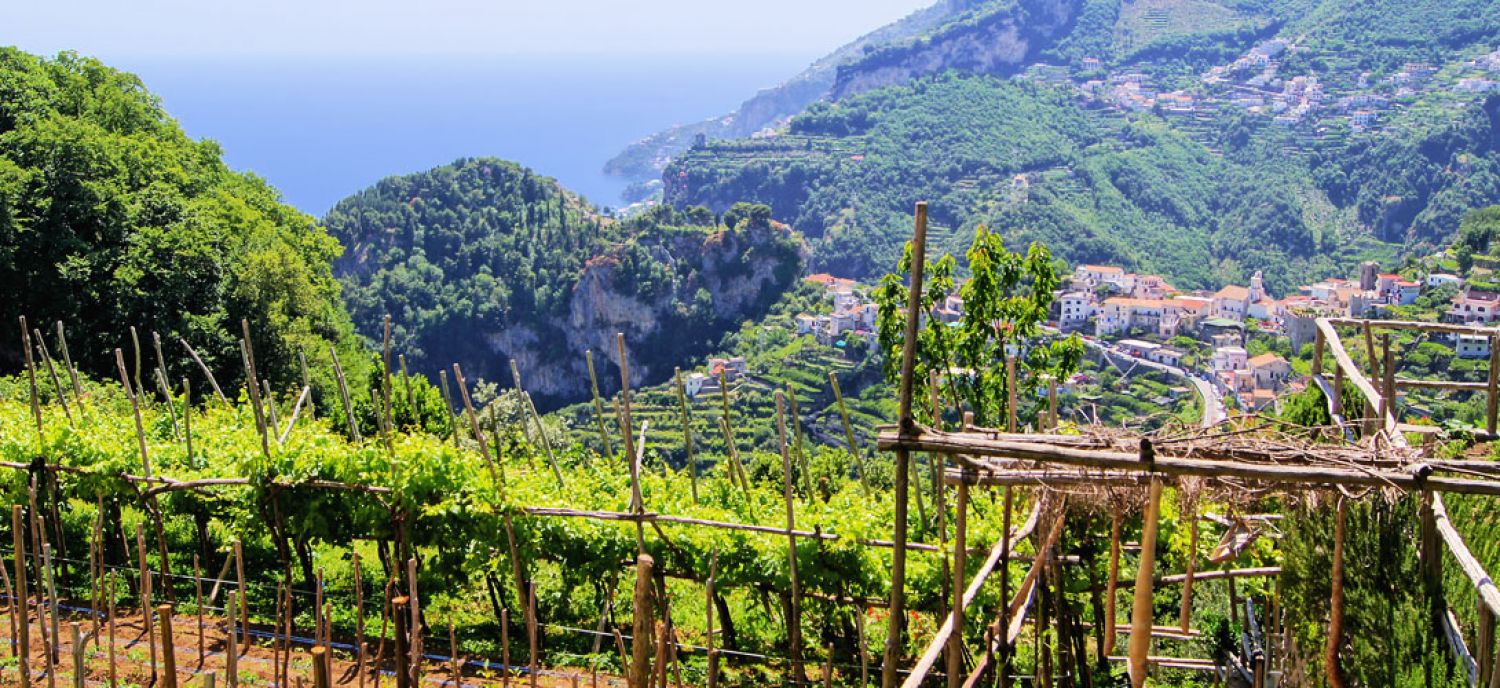
Inland, in the high hills of Irpinia, elevations range between 400 and 700 meters, and soils shift to calcareous clay, marl, and tufa, offering ideal conditions for late-ripening varieties like Aglianico, Greco, and Fiano. The climate here is more continental, with cool nights and fog-prone valleys, leading to high diurnal temperature variation that preserves acidity and slows phenolic ripening. This is essential for producing wines of structure and longevity. In the Sannio and Cilentoareas, the soils become more mixed, with limestone, sandstone, and clay interspersed throughout rolling hills and flatter plains. Along the coast, from the Amalfi Coast to the islands of Capri and Ischia, vineyards are often planted on steep, terraced slopes facing the sea. These maritime sites benefit from breezes that moderate the heat and reduce disease pressure, while also imbuing the wines with brightness and finesse. The result is a patchwork of microclimates that allows for both crisp, age-worthy whites and powerful, complex reds—all underpinned by Campania’s dynamic geological history.
Campania is one of Italy’s most important regions for indigenous grape varieties, many of which are unique to southern Italy and have been cultivated since antiquity. Among reds, the undisputed king is Aglianico, a late-ripening grape believed to have been introduced by the Greeks. It thrives in the high altitudes and volcanic-clay soils of Irpinia, where it forms the base of Taurasi and other serious red wines. Aglianico yields dark, tannic, age-worthy wines with flavors of black cherry, plum skin, iron, and tobacco. In coastal zones and volcanic areas like Campi Flegrei, Piedirosso is more common, producing medium-bodied, fragrant reds with soft tannins and wild berry notes. Sciascinoso, a lesser-known native grape, is also used in blends for lighter reds and rosés.
Among whites, Falanghina is the most widely planted and versatile variety, appearing in both still and sparkling forms across the region. It produces wines with bright acidity, citrus zest, floral notes, and, in volcanic zones, a pronounced mineral finish. Fiano, particularly from Avellino, is more textured and complex, capable of developing honeyed, nutty, and herbal flavors with age. Greco, grown primarily in Tufo, yields wines with strong structure, citrus and stone fruit notes, and a saline core that reflects the tuffaceous soils. Other local white grapes include Coda di Volpe, often used in Vesuvio DOC blends, and Biancolella and Forastera, grown on Ischia and the Amalfi Coast. Campania’s grape heritage is vast, and its top producers are increasingly committed to preserving and elevating these native varieties, many of which have little presence outside the region.
Campania is home to a diverse range of appellations, including four DOCGs and more than fifteen DOCs, many of which center on the volcanic and mountainous inland area of Irpinia, northeast of Naples. The region’s most prestigious red wines come from the Taurasi DOCG, which was established in 1993 and is based entirely on Aglianico, often called the “Barolo of the South.” Taurasi must be aged for a minimum of three years (four for Riserva), with its high acidity and robust tannins contributing to its longevity. The three other DOCGs are all white wine zones: Greco di Tufo DOCG, Fiano di Avellino DOCG, and Falanghina del Sannio DOCG, with the first two also located in Irpinia. Greco di Tufo and Fiano di Avellino produce highly mineral, structured white wines that can age for a decade or more, while Falanghina del Sannio, elevated to DOCG more recently, is known for its floral aromatics, citrus, and freshness.
Beyond the DOCGs, the Campi Flegrei DOC west of Naples is gaining recognition for its distinctive wines from Piedirosso and Falanghina, grown in sandy volcanic soils near the sea. Ischia DOC, covering wines from the island of Ischia, uses similar varieties and benefits from coastal breezes and marine influences. The Costa d’Amalfi DOC produces light, aromatic wines from steep, terraced vineyards along the Amalfi Coast, while Vesuvio DOC, on the slopes of Mount Vesuvius, includes the legendary Lacryma Christi wines made from a mix of white and red native grapes. Sannio DOCand Cilento DOC round out the picture, offering flexible rules and a wide array of varietal wines, including Greco, Falanghina, and Aglianico in various forms. Together, these denominations reveal the geographic and stylistic diversitythat defines Campania’s modern wine landscape.
Campania today stands at the forefront of southern Italy’s qualitative revival, with a wave of producers embracing both tradition and experimentation. One major trend is the growing emphasis on terroir expression, particularly in Irpinia, where single-vineyard bottlings of Taurasi, Fiano, and Greco are becoming more common. This reflects a broader movement toward transparency and precision, as winemakers seek to highlight the differences between hillside parcels, soil types, and microclimates. Alongside this, there is increasing interest in organic and sustainable viticulture, particularly in coastal and island appellations where environmental concerns are more pronounced.
A second trend is the resurgence of native grapes beyond the core three of Aglianico, Fiano, and Greco. Grapes like Piedirosso, Coda di Volpe, Biancolella, and Catalanesca are being rediscovered and vinified as monovarietal wines, giving consumers a more complete picture of Campania’s diverse vinous identity. In addition, producers are experimenting with amphorae, extended skin contact, and spontaneous fermentation, often under IGT labels, to offer a naturalistic counterpoint to more polished DOCG wines. International markets, particularly in North America and northern Europe, are increasingly responding to Campania’s distinctiveness—drawn to wines that offer volcanic minerality, aromatic complexity, and cultural authenticity. Though still underappreciated compared to regions like Tuscany and Piedmont, Campania is rapidly becoming one of Italy’s most compelling and dynamic wine regions, fueled by deep roots and bold ambition.

